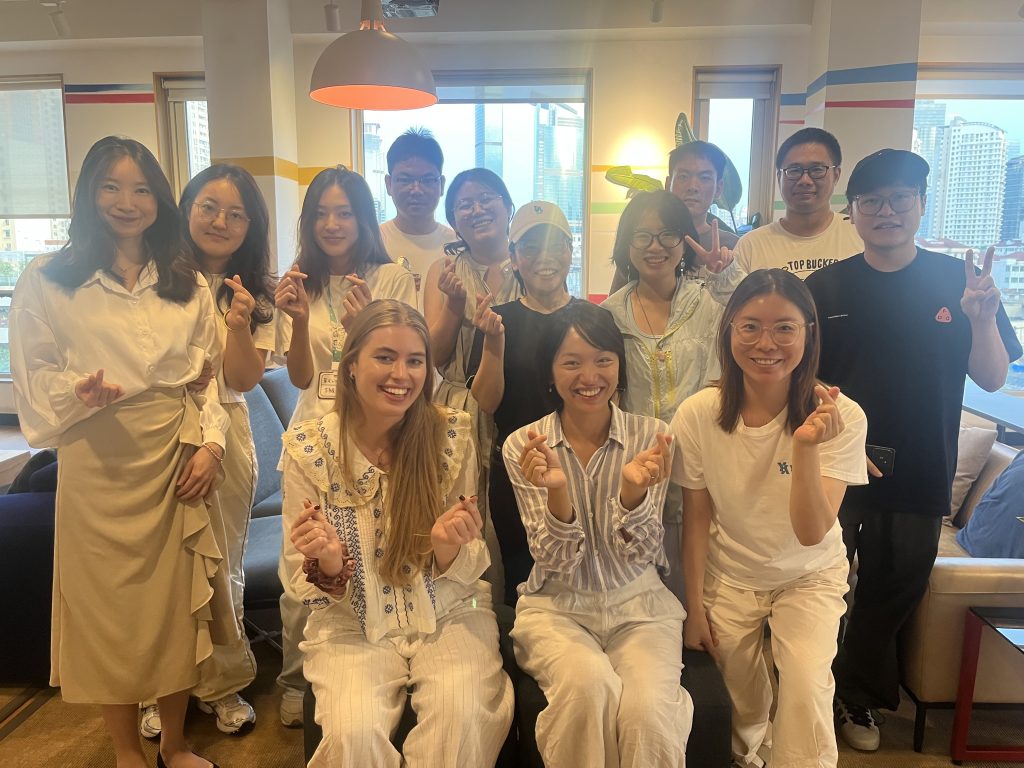
From London to Shanghai: My experience of how YASO is unlocking China for global brands
04min read

Emily Bourne, Investment Manager, shares insights from her recent trip to China to visit YASO – a platform helping global brands thrive in the world’s fastest-moving e-commerce market.
I learnt I was off to China less than a week before I was due to fly.
Due to a backlog of visas at the Chinese embassy in London, I wasn’t sure if I would make it. But thanks to a fair bit of persistence with a patient man at a visa agency in Victoria, I had a stamped and signed passport allowing my entry into China within just five days.
The purpose of my trip was to check out YASO, a business we went on to invest in during September ‘25. YASO’s platform enables global brands to scale up in China by offering logistics, payments, warehousing and listing of their products via China’s diverse range of social and e-commerce platforms.
My initial goal was simple: check it all exists – the people, the office, the warehouses. But really I knew there was much more resting on the trip. The majority of our portfolio is UK-based. YASO is too, with their sales and founding team in the UK – but the beating heart of the operation – the logistics, ecommerce and operations, are all based in Shanghai, and their warehouses three hours south in Ningbo. I knew I had a lot to learn to be able to show our Investment Committee that making a foray into a market distinct in every way from our own was a good idea.
A primary driver of YASO’s phenomenal growth has been their ability to integrate with social commerce platforms like Douyin (Chinese Tiktok) which have grown enormously as shopping channels in recent years. Incumbent e-commerce partners do not have the technical expertise of a purpose-built scale-up like YASO and have struggled to keep up with the eye-watering pace of change.
YASO’s offer intricately links technology and infrastructure to offer a streamlined service. A highlight of my trip was visiting YASO’s warehouses in Ningbo. Picking and packing engines, with cameras everywhere feeding live to Alibaba and customs. E-commerce sales revolve around promotional shopping festivals like 6/18 (June 18th) and Singles’ Day (11th November). During these periods, warehouse capacity and speed need to increase five to ten-fold, with hundreds of thousands of parcels dispatched daily. Should warehouses achieve anything less than 99% accuracy, they are fined. When launching in China, brands must expect their sales to fluctuate in line with these festivals, a reason why local know-how is essential.
The art of influencing rules brands’ success in China. Known as Key Opinion Leaders, ‘KOLs’, they are more than just influencers: they are shopfronts for brands. Choosing the right KOL to champion your product is everything and requires serious consideration as to the possible buyer, an area YASO assists with closely.
This brings me to the malls. I was keen to look round a few to better understand the Chinese customer and how they shop. I was particularly interested to see how beauty was operating and had a few immediate observations. There are no drugstores in China. There is the odd Sephora but they are dying and empty. As a Brit, I find the bright lights of Boots quite comforting. In China, familiarity is retail suicide. Shops change every 6 months, a rotation of ‘IP rich’ experiences designed to shock and excite. The most astonishing of which was a vagazzled Cutty Sark-esque ship in the centre of Shanghai, which was, naturally, Louis Vuitton’s flagship store.
The takeaway is this: the Chinese customer is demanding. The only beauty store I saw packed was one only selling samples because nobody wants to commit to large bottles on their first purchase. Despite this, customers are willing to try new products and whole categories can launch in months. Home scenting did not exist until just a few years ago, now the malls are lined with Aesops and Diptyques and a number of high-end Chinese alternatives. Western brands must sniff out products and categories that haven’t yet become a thing in China, or else China will get there first (and cheaper).
A key point of note is that nobody actually buys anything in the shops. The malls are adverts, the supermarkets a gamified experience where customers scan what they want and 30 minutes later Alibaba delivers everything to their door. This extends to cafés and restaurants. Every morning, bemused, I waited 15 minutes for my cappuccino despite being the only customer, as I was behind a backlog of coffees pre-ordered on WeChat.
You realise quickly that while, for locals, China moves ten times quicker than the rest of the world, as a foreigner with no Chinese, there is friction. You can’t pay with your credit card (WeChat pay or Alibaba only); everything else you buy is done via apps which offer instant delivery, gradually disintermediating the corner shop market. But if you can’t speak Chinese, good luck trying navigate an entirely Mandarin interface to buy tampons at 11pm.
And this is precisely why YASO exists. Yes, China is becoming more accessible to tourists and business owners, but nevertheless every one of YASO’s customers described it as a ‘black hole’ unless you have the right partner to support you in the market. Instant access to sales data, marketing analytics: information we take for granted across much of the world. But until today, China’s ecommerce partners were legacy distributors who might have provided brands with a PDF every 2 months. Meanwhile, YASO’s tech integrates brands directly with social and ecommerce platforms, feeding them with a live dashboard of sales data, allowing them to make dynamic merchandising decisions.
In a market so advanced, YASO is one of the few platforms offering a service in keeping with impatience of the customer.